The dominant story about Artificial Intelligence is still childish. One side of the market sells the fantasy of total replacement: machines taking over human functions at scale, dissolving professions, reducing people to biological overhead. The other side reacts with the opposite reflex: it romanticizes human value in vague terms, as if “sensitivity,” “soul,” and “creativity” were enough to defend against systems that process information at industrial scale. Both visions fail for the same reason. They treat the relationship between humans and machines as a binary fight. That is not what is happening.
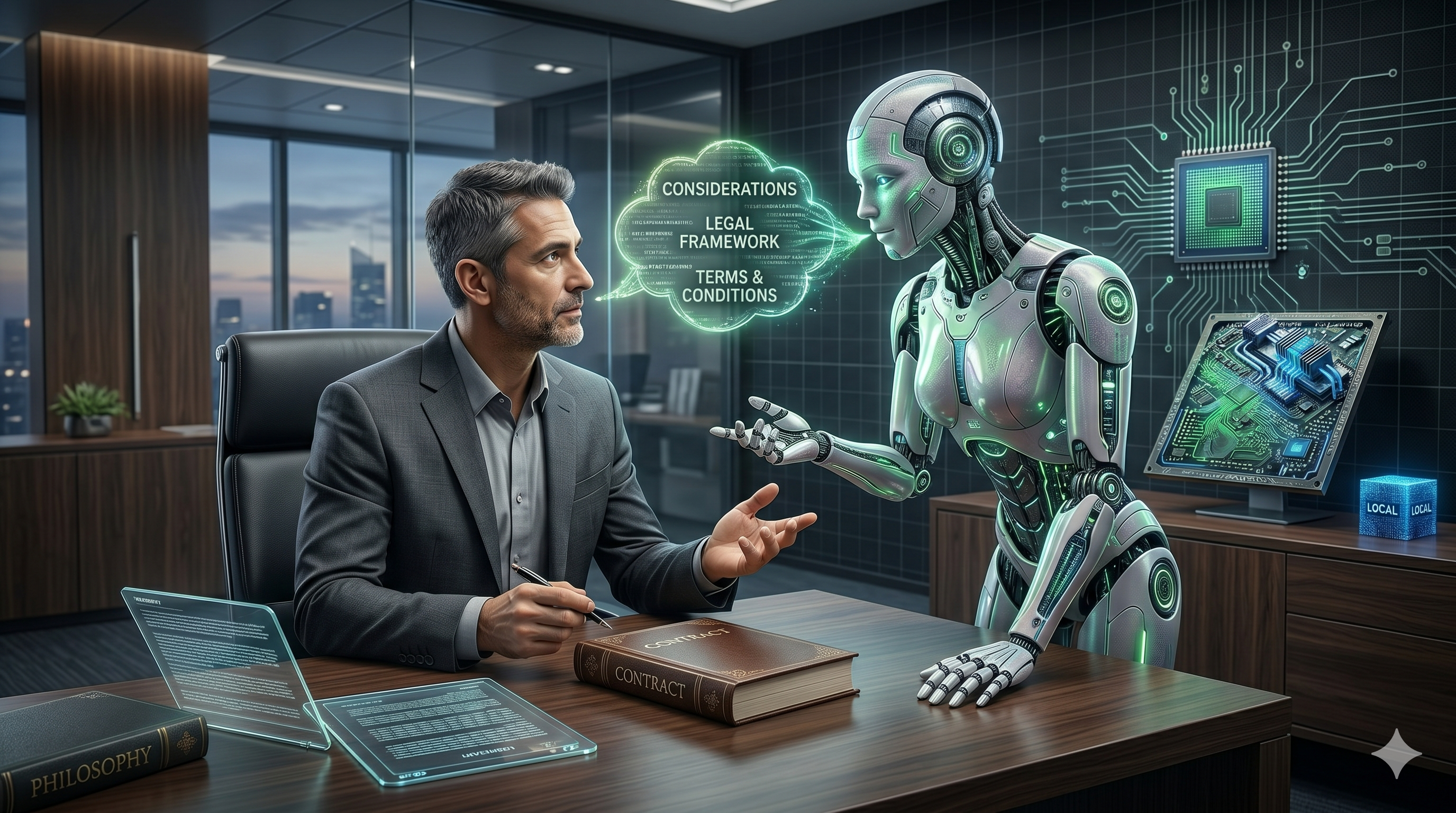
The more important transformation is not one side defeating the other. It is the emergence of a new operating contract. In that contract, the human stops being the exhausted executor of repetitive tasks and becomes the architect of context, the judge of quality, the definer of priority, the holder of responsibility, and the source of direction. The machine, in turn, stops being a passive tool and starts functioning as an engine for cognitive acceleration, synthesis, variation, triage, and structural execution. That is symbiosis. Not sentimental harmony. Not mystical fusion. Symbiosis in the hard sense: complementary specialization under real pressure.
The Replacement Myth
The idea of total replacement is intellectually lazy because it ignores what work actually is. Almost no relevant profession consists of a single isolated task. Human work is a mixed bundle of judgment, improvisation, accountability, negotiation, institutional memory, contextual reading, social adaptation, and technical execution. When AI enters the picture, it does not swallow that whole bundle. It slices it apart. And that slicing changes everything.
One part of work is highly compressible: summarizing documents, reorganizing information, proposing structures, generating variations, automating repetitive flows, detecting patterns, and accelerating the first layer of production. Another part remains deeply dependent on situated decision-making: what is worth publishing, what should not be said, what legal risk exists, what tone is appropriate, what error is tolerable, what objective deserves priority. People who describe the future as “AI will replace profession X” are usually treating a role as if it were an indivisible block. That mistake poisons the analysis before it even starts.
What is being replaced is not the human as such. It is the inefficient use of the human. The professional who only repeats formulas, repackages the obvious, and executes without criteria is at risk because that function was already fragile before AI. The professional who can formulate problems, evaluate nuance, create standards, interpret consequences, and organize distributed intelligence does not disappear. That person changes position in the value chain. In many cases, that person moves up.
What Remains Human
There is an almost religious insistence on saying that “humans will always be better.” Better at what? That question has to be asked without self-pity. The machine is already better at speed, formal consistency, short-range operational memory, and large-scale exploration of alternatives. Defending human superiority in the abstract is not strategy. It is anesthesia.
Real human value sits in other layers. It sits in choosing the right question before the answer. It sits in understanding the moral and reputational cost of a decision. It sits in recognizing when a technically elegant solution is socially stupid. It sits in knowing that the context of an organization, a market, or a community changes the validity of any recommendation. It sits in distinguishing between local performance and systemic effect.
AI can help write a policy. It does not bear responsibility for that policy. It can generate ten editorial positioning paths. It does not answer for the public consequences of the choice. It can structure comparisons, syntheses, workflows, and hypotheses. It does not live inside the institutional force field where decisions actually matter. Humans still carry the burden of judgment. And that burden, far from being a weakness, becomes their economic core.
What the Machine Does Better
That said, symbiosis only works when humans drop the narcissism and accept what the machine does better. AI is superior in scale of exploration. It tests variations without fatigue, crosses large text collections in seconds, produces multiple solution skeletons, and reduces the friction between intention and first draft. In well-designed environments, that changes productivity radically.
The gain, however, is not just about doing old work faster. It is about making previously uneconomical work possible. A small editorial operation can analyze massive amounts of material. An independent professional can compete with larger structures. A lean team can operate with depth that used to belong only to broad organizations. Well-implemented symbiosis is not just a time-saving device. It resets the boundary of what is feasible.
But that only happens when the machine is treated as a work system rather than a spectacle. Many companies buy AI to display modernity while staying trapped in badly defined processes, messy knowledge bases, and confused goals. Then they conclude that “AI doesn’t deliver.” It does. It just does not compensate for strategic disorder. Symbiosis requires workflow design, validation criteria, and a clear hierarchy between generation and decision.
The Interface Is the New Battleground
For a long time, professional competence was concentrated in direct execution. The person who could manually do the work controlled the process. Now, a growing part of the advantage is shifting to the interface between human and system. Knowing how to use AI is not about writing flashy prompts. It is about decomposing problems, supplying useful context, constraining ambiguity, calibrating the model’s freedom, and reviewing the output with rigor.
The interface has become the place where human intelligence is converted into operational power. People who master that layer do not outsource thought; they amplify it. People who do not master it become dependent on mediocre output and start blaming the tool for what is really a failure of direction. The new strong professional is not the one who insists on doing everything alone out of pride. It is the one who knows how to orchestrate.
That shift also punctures the vanity of the isolated genius. In many sectors, excellence will depend less on raw individual performance and more on the ability to coordinate hybrid systems. The outstanding operator will be the one who combines human repertoire, institutional context, and artificial acceleration without losing consistency or accountability.
Symbiosis Is a Discipline, Not a Mood
There is a subtle danger in treating symbiosis as a nice conference word. Declaring a partnership between human and AI is not enough. It has to be designed. That means deciding what can be automated, what must be reviewed, what should never be delegated, and at what point human validation becomes mandatory. Without that architecture, symbiosis turns into improvisation. And improvisation with AI usually means high-speed error.
Mature organizations will differentiate themselves less by “having AI” than by knowing exactly where it enters, where it stops, and who answers when performance degrades. That maturity has less glamour than disruption rhetoric, but it creates far more value. Because the useful future does not belong to the fantasy of total autonomy. It belongs to systems where the machine accelerates without unmooring judgment.
The New Professional Profile
The professional of the next cycle will not be defined only by raw technical knowledge. That person will be defined by the ability to formulate, select, validate, and integrate. Instead of competing with the machine on volume, they will compete on direction. Instead of proving value through fatigue, they will prove value through the curation of intelligence. That applies to marketing, content, research, support, product, education, and almost any activity driven by information.
Those who understand this early will gain an outsized advantage. Not because AI will do the work for them, but because they will stop burning energy where human contribution is weak and begin concentrating force where human contribution is still decisive. That shift is the real gain. Not the fantasy of absolute automation, but the deliberate redesign of the human role.
The machine did not arrive to abolish the human. It arrived to expose where the human is actually worth something. Everything else was wasted effort disguised as work.