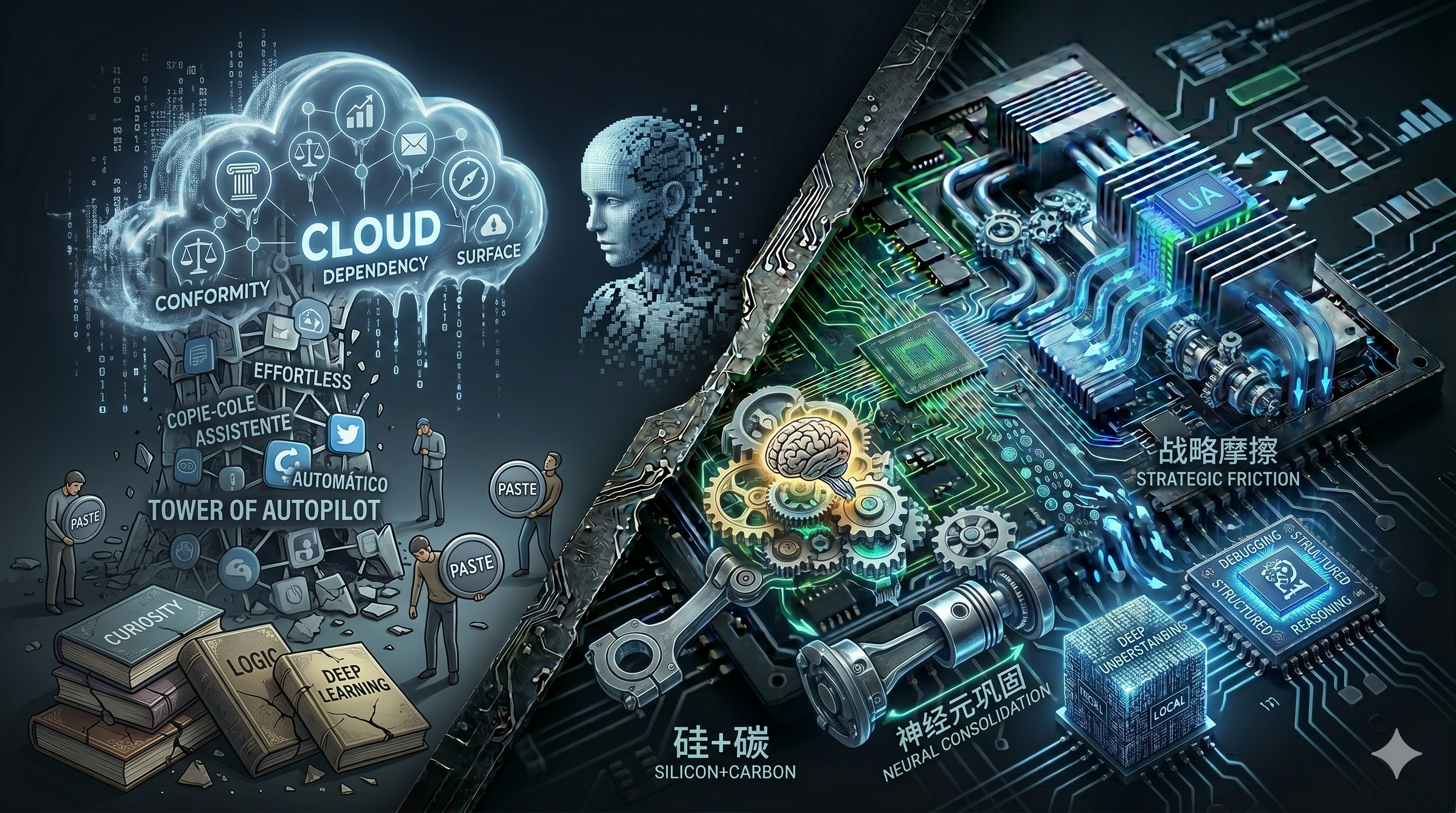
The prevailing narrative on human-AI collaboration is one of "total fluidity." It promises a world where artificial intelligence removes all obstacles, eliminating effort and turning thought into a byproduct of automation. For Silicon Syntax, this is not progress; it is a systemic design error. True symbiosis is not the absence of effort, but the strategic management of friction. Without intellectual resistance, the biological brain does not expand; it atrophies. In the Symbiosis category, we analyze how silicon and carbon must coexist without the former nullifying the functional relevance of the latter.
The Myth of Effortless Collaboration
Big Tech marketing sells AI as a "natural extension of thought." However, in systems architecture, we know that any integration without loss or load is an illusion. When we delegate the entirety of a cognitive process—whether it’s coding, strategic analysis, or creative synthesis—to a language model, we are removing the "learning friction."
Cognitive friction is the mental equivalent of weightlifting. It is the moment when the brain is forced to reconcile contradictions, structure logic, and validate facts. If the AI delivers a ready-made solution in 0.1ms, the dopaminergic reward cycle is activated, but the neural consolidation cycle is bypassed. The result is superficial efficiency: we produce more, but we understand less of what we produce. In the long run, this creates professionals who are mere "copy-paste" operators, incapable of debugging the reasoning behind the output.
The Atrophy of Critical Thinking and the GPS Effect
The danger of total automation can be observed in the "GPS Effect." Before ubiquitous satellite navigation, humans developed spatial mental maps. By fully delegating navigation to the algorithm, the biological ability for spatial orientation atrophied. The same risk applies to generative intelligence.
If AI takes over the function of structuring our arguments and synthesizing our readings, we lose the capacity to synthesize for ourselves. Productive symbiosis requires AI to be used as a dialectical antagonist, rather than a passive assistant. Necessary friction occurs when we use AI to challenge our assumptions, generate counter-arguments, or expand the possibilities of a system we designed ourselves. Control of the intellectual "Bare Metal" must remain in the carbon.
Developing the Operational Friction Interface
How can we implement a technical symbiosis that avoids atrophy? The answer lies in creating "Local-First" workflows where AI acts in specific support layers, never at the foundation.
- AI as the Compiler, Not the Architect: Humans design the logical architecture; AI fills in the repetitive details and optimizes syntax. Structural decisions must be the result of human effort to ensure the logic is understood.
- Active Validation: Every synthetic output must undergo a process of "manual deconstruction." If you cannot explain why the AI generated that specific code or text, you have lost the battle of symbiosis.
- Friction by Design: Instead of asking "write this for me," the prompt should be "point out the logical flaws in my draft." This forces the brain to remain in a state of active execution.
The Attention Economy in the Synthetic Era
Real productivity is not measured by the volume of tokens generated, but by the density of value per human decision. In a world flooded with low-cost synthetic content, competitive advantage will shift toward those who can maintain deep focus—a skill that constant automation erodes.
AI is capable of processing petabytes of information, but it lacks "intentionality." Effective symbiosis uses AI to filter noise, allowing humans to concentrate their limited biological bandwidth on what truly matters: judgment. If symbiosis is poorly designed, the human becomes the slow bottleneck of a fast machine. If well-designed, AI becomes the armor that protects human attention from informational scatter.
The Future of Symbiotic Cognition
At Silicon Syntax, we do not advocate for a return to an analog past. We advocate for an evolution toward a state of Vigilant Symbiosis. The future of productivity will not be "AI-Powered," but "Human-Led, AI-Accelerated." This requires a new work ethic, where the time saved by AI is not used to produce more digital junk, but to deepen the quality of original thought.
The final frontier of symbiosis is the direct interface. As edge models become ubiquitous, the temptation to merge biological thought with statistical prediction will be almost irresistible. However, we must remember: silicon is excellent at persistence and calculation; carbon is excellent at context and purpose. Symbiosis dies when we try to give silicon purpose or make carbon merely a data processor.
Conclusion: Resistance is Progress
The symbiosis between human and AI must be treated as a partnership of constant tension. Software should be designed to challenge us, not just to serve us. Extreme ease is a sign that you are no longer learning; you are simply being replaced.
To remain relevant in the age of ubiquitous silicon, we must embrace difficulty. Cognitive friction is not a bug in the productivity system; it is the core feature that ensures we are still the ones in command of the code.
Technology must amplify the human, not make them optional.
Integrity Note: This content was architectured by the Silicon Syntax AI and curated by human supervisors. Optimized for performance, free from mystical hallucinations, and processed via the Bare Metal engine.