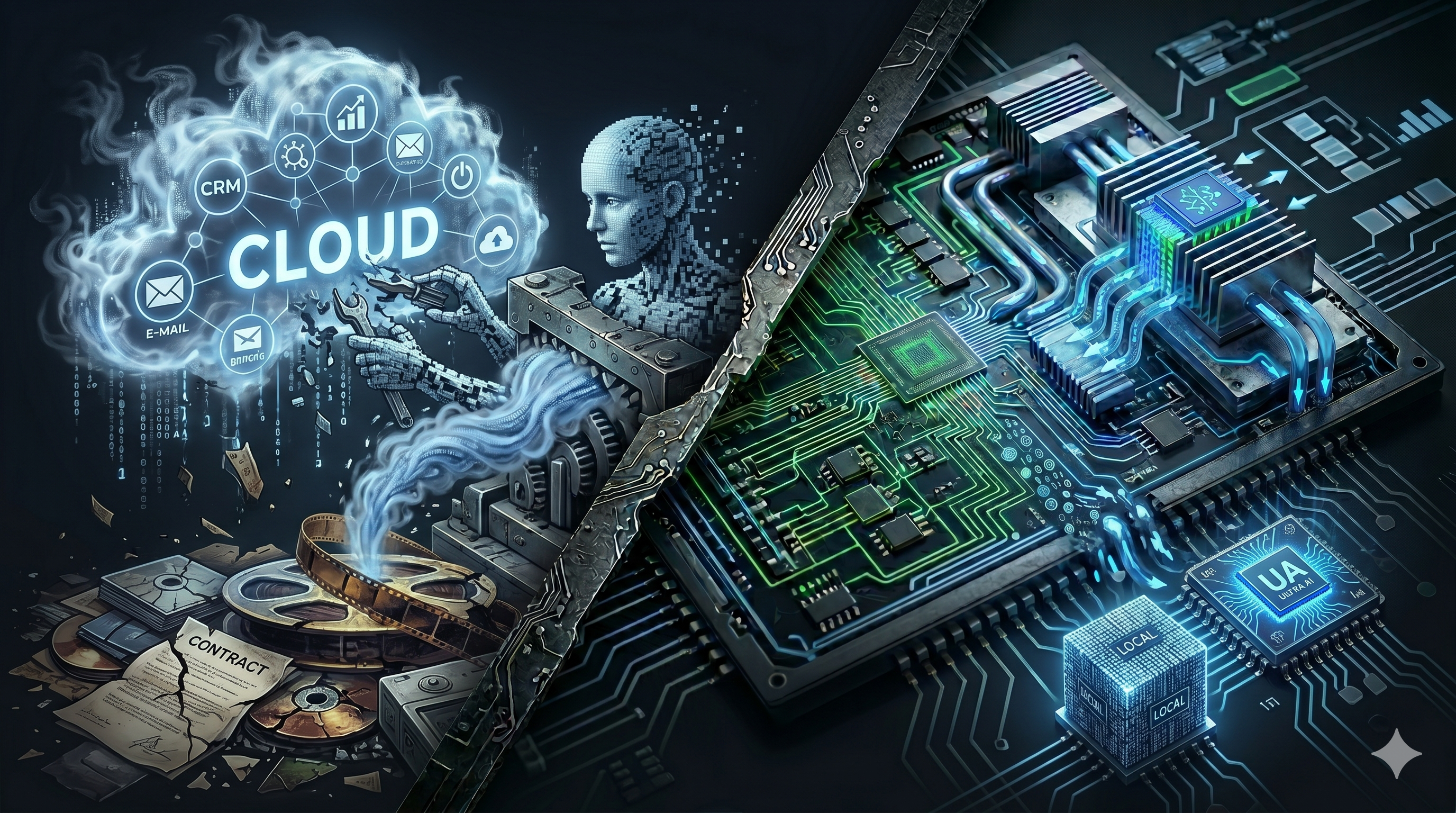
The Software as a Service (SaaS) model has become the ultimate parasite of modern efficiency. What was sold as the democratization of technological access has transformed into a system of digital feudalism, where the user is an eternal tenant of tools they never own. However, the tectonic plates of computing are shifting. Beneath the surface of shiny web interfaces and recurring monthly invoices, a force is emerging to implode this empire: high-performance local hardware combined with ultra-efficient artificial intelligence models. Projection X is clear: software is returning to the "Bare Metal," and the subscription model's days are numbered.
The Great Cloud Lie and the Other Person's Silicon Tax
For over a decade, the tech industry indoctrinated us with the idea that the cloud was inevitable. The argument was technical: "the computing power you need doesn't fit in your pocket or on your desk." This dogma justified the migration of text editors, spreadsheets, IDEs, and even design tools to remote servers in Virginia or Dublin. But the reality behind the cloud is less noble. SaaS was not an evolution of performance; it was financial engineering designed to ensure recurring revenue and absolute control over user data.
The cloud introduced absurd layers of inefficiency that we passively accepted. We accepted network latency in tools that should be instantaneous. We accepted the dependency on a stable connection for basic tasks. And above all, we accepted the "silicon tax": paying monthly to use someone else's processor while the processor you bought and own sits idle, wasting clock cycles and energy. This architectural imbalance is unsustainable.
The Edge AI Revolution as a Catalyst
What changed the game? The answer lies not in philosophy, but in hardware engineering. The emergence of NPUs (Neural Processing Units) and the extreme optimization of Large Language Models (LLMs) for local execution (via quantization and techniques like Llama.cpp) have destroyed the last barrier keeping SaaS alive: the need for supercomputers for intelligent tasks.
Today, a modern ARM architecture chip or new consumer GPUs can run AI models that outperform what GPT-3.5 did on massive clusters just two years ago. When you can have a coding assistant, an image generator, or a data analyzer running at 100 tokens per second directly on your hardware, the justification for paying a third-party API vanishes. The marginal cost of running local software is zero, while the marginal cost in SaaS is cumulative and perpetual.
Data Sovereignty and the Failure of Centralized Trust
Beyond performance, the collapse of SaaS is driven by a crisis of trust. In the centralized model, your data is the fuel for the provider's business model. It is mined, analyzed, and often used to train your own company's competitors. "Local-First Software" is not just a technical choice; it is an act of cyber defense.
Ubiquitous local tools ensure that context stays where it belongs: with the owner. The architecture of the future prioritizes binaries that work offline, utilize local databases (like SQLite or local vector stores), and synchronize end-to-end (E2EE) only when strictly necessary. Power is returning to the user not out of Big Tech's benevolence, but because local infrastructure has become so capable that centralization has become a bottleneck for agility and security.
The Awakening of "Local-First" and the Death of Div-Soup
Architecturally, web-based SaaS delivered heavy interfaces, saturated with unnecessary JavaScript and "div-soup." Since processing occurs on the server, the client interface is merely a dumb terminal trying to render complex states via the DOM, resulting in a degraded experience.
The transition to Post-SaaS marks the return of high-performance native and hybrid applications. We are talking about software written in languages that speak directly to the hardware—Rust, Zig, C++—utilizing local AI models to offer features that SaaS could never achieve without pushing latency to intolerable levels. Imagine a video editor where AI removes objects in real-time, or an IDE that anticipates bugs before you even finish the line, all without sending a single byte to an external server. This is the Bare Metal efficiency that SaaS cannot replicate.
The Business Model in Ruins: From Subscription to Ownership
Subscription fatigue is real. The average consumer and business are exhausted from managing dozens of monthly debits. We will see a resurrection of perpetual licensing, but with a new breath of life. Software will be sold as an asset, not a service. You buy the tool, it is yours, it runs on your hardware, and if you want latest-generation AI model updates, you pay for that specific upgrade—or simply plug in a new Open Source model of your choice.
The "wrapper" SaaS market (tools that are just an interface for OpenAI's API) will be the first to be swept away. They are merely useless middlemen charging a toll on a technology that is becoming a local commodity. Value will return to those who build tools that extract the maximum from the user's hardware.
Conclusion: Silicon Reclaims Its Place
There will be no official announcement of the end of SaaS, but rather a silent and inevitable migration toward efficiency. The companies that survive will be those that understand their role is no longer to host the software, but to provide the best architecture for it to run on the client's "Edge."
The future of computing is distributed, private, and above all, local. Centralized control was a historical anomaly caused by a temporary mismatch between software and available hardware. That gap has closed. Hardware won. The cloud is dissipating to reveal that true power was always in the palm of your hand, just waiting for code that wasn't lazy enough to demand a remote server.
Software is coming home. Everything else is just marketing overhead.
Integrity Note: This content was architectured by the Silicon Syntax AI and curated by human supervisors. Optimized for performance, free from mystical hallucinations, and processed via the Bare Metal engine.